![[USLNG Logo]](https://lngallies.com/wp-content/themes/lng-allies/assets/images/lng-logo-2026.png)
Norwegian Gas Decline
Anne-Sophie Corbeau, Center on Global Energy Policy, Columbia University | SIPA
LinkedIn, May 13, 2026
Norway’s approval of three gas field restarts—Albuskjell, Vest Ekofisk, and Tommeliten Gamma—made headlines this week. Anne-Sophie Corbeau of Columbia’s Center on Global Energy Policy offers a useful reality check: at 90-120 million barrels of oil equivalent in gas and condensates, the three fields represent a maximum of 19 bcm over 20 years, or ≈1 bcm/y. That is roughly 10 LNG cargoes annually. Welcome, but not transformative.
The more consequential question, Corbeau argues, is how Norwegian production evolves over the next decade. Norway currently supplies Europe with ≈120 bcm/y, making it the continent’s single largest gas supplier. The Norsk Petroleum chart she cites projects a significant production decline beginning around 2026-2027, with a 20-25 bcm/y spread between high and low case scenarios by 2035. New licensing blocks offered last week may help at the margins, but the direction of the curve is clear.
The implication for EU and U.K. policymakers is straightforward: if Norwegian production declines faster than European gas demand falls—which remains an open question given industrial load, heating demand, and the pace of electrification—Europe will need to source additional volumes from elsewhere. With Russian pipeline gas effectively off the table through policy choice and Qatari expansion timelines pushed past 2030 by the Gulf conflict, the supply arithmetic continues to point in one direction.
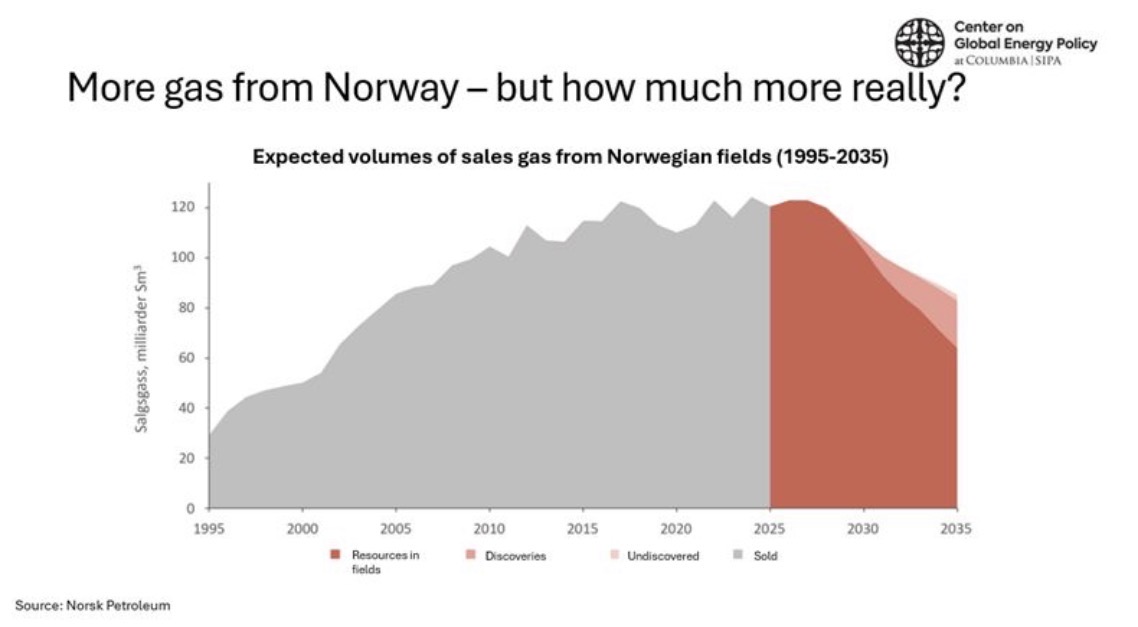
Source: Anne-Sophie Corbeau, LinkedIn | Chart: Center on Global Energy Policy, Columbia University | SIPA →