![[USLNG Logo]](https://lngallies.com/wp-content/themes/lng-allies/assets/images/lng-logo-2026.png)
Global Markets
USLNG has revolutionized how LNG is bought and sold in global markets.
At a Glance
- Prior to February 24, 2016, the global LNG market was dominated by rigid, oil-indexed, destination-restricted contracts that gave buyers little leverage and entrenched incumbent producers.
- The American export contract model introduced Henry Hub pricing, destination flexibility, and smaller take-or-pay obligations, transforming LNG from a bilateral commodity into a global liquid market.
- USLNG forced other producing countries to compete on terms they previously would have rejected, permanently improving market conditions for every LNG buyer in the world.
- The growth of LNG spot trading, portfolio players, and price transparency all trace directly to the structural changes USLNG introduced.
The Market Before USLNG
To understand what USLNG changed, it helps to understand what the global LNG market looked like before the first American cargo sailed in February 2016.
LNG was traded almost exclusively under long-term, bilateral contracts (typically 20–25 years) between a specific producer and a specific buyer. Pricing was indexed to crude oil, which meant that LNG buyers had no independent price signal—they were simply paying whatever the oil market dictated, with no ability to hedge using a transparent, liquid benchmark. Destination clauses prohibited buyers from redirecting cargoes to other markets, even if prices elsewhere were significantly higher. Take-or-pay obligations required buyers to pay for contracted volumes whether they needed them or not, locking up capital and limiting flexibility. The market was opaque, illiquid, and designed to serve the interests of incumbent producers in the Middle East, Australia, and Southeast Asia.
Buyers—European utilities, Japanese trading houses, Korean state energy companies—had limited leverage. Sellers dictated terms. Gazprom could weaponize its pipeline gas because buyers had few alternatives and no market mechanisms to quickly substitute supply. The Asian LNG premium, the chronic price gap between Asian and European gas markets, persisted for years because buyers lacked the contractual flexibility to arbitrage the difference.
What the American Model Introduced
USLNG export contracts, pioneered by Cheniere Energy at Sabine Pass and quickly adopted across the industry, departed from the incumbent model in nearly every structural respect.
Henry Hub Indexing. USLNG is priced at a fixed spread over the Henry Hub natural gas spot price, the world’s most liquid and transparent natural gas benchmark. For the first time, LNG buyers had a price signal they could observe, forecast, and hedge using a deep, liquid futures market. Henry Hub pricing decoupled LNG from crude oil, reducing the volatility and opacity that had long characterized the market.
Destination Flexibility. USLNG contracts typically allow buyers to redirect cargoes to any permitted destination, or to resell volumes they don’t need in the spot market. This single feature transformed the market. A European buyer holding a USLNG contract could sell excess volumes to Asia when Asian prices were higher. A Korean utility could redirect a cargo to Europe during a warm winter in Seoul. Destination flexibility created genuine market liquidity, enabling price discovery and arbitrage that simply did not exist before.
Smaller Take-or-Pay Obligations. USLNG export contracts generally carry lower take-or-pay requirements than their legacy counterparts, reducing the capital commitment required to enter the market and lowering the barrier for smaller buyers, new market entrants, and portfolio players. This democratized access to LNG supply in ways that benefited importers across the developing world. It also provided a much-needed relief mechanism when COVID decimated global LNG demand in mid-2020.
Shorter Contract Terms. While long-term contracts remain the backbone of project financing, the USLNG era has seen the emergence of shorter-term deals (10–15 years) alongside the traditional 20–25 year agreements, giving buyers more flexibility to adjust their supply portfolios as markets evolve.
Portfolio Players and Aggregators. The American model created space for trading companies, portfolio players, and LNG aggregators to buy USLNG volumes and resell them across global markets, adding liquidity, intermediation, and price discovery that the old bilateral model never allowed. TotalEnergies, Shell, BP, Vitol, Trafigura, and others have built significant LNG trading businesses substantially on USLNG supply.
The Competitive Pressure on Incumbents
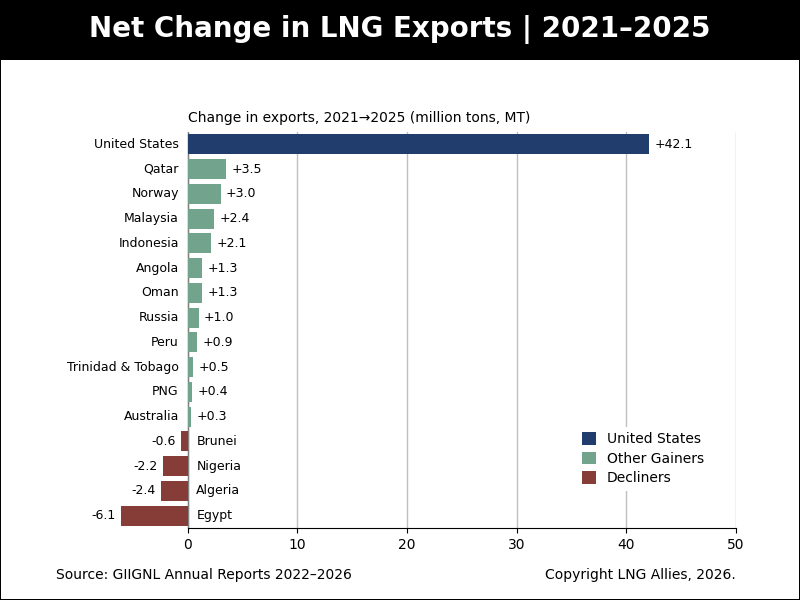
The arrival of USLNG in global markets did not simply add new supply. It changed the terms on which all supply was traded. Qatar, which had long maintained strict destination restrictions on its LNG contracts, was compelled to relax them as European and Asian buyers gained access to flexible American alternatives. Australian producers, whose contracts had been among the most rigidly structured in the market, also faced pressure to offer more competitive terms to buyers who could now credibly threaten to sign with an American exporter instead.
This competitive pressure benefited every LNG buyer in the world, including those who never signed a single USLNG contract. The mere existence of a flexible, Henry Hub-indexed, destination-free American supply option improved the negotiating position of buyers everywhere. Market structure improved not just for USLNG customers, but for the global LNG market as a whole.
The Growth of LNG Spot Trading
One of the most visible consequences of USLNG’s market revolution is the dramatic growth of LNG spot and short-term trading. Before USLNG, spot LNG represented a small fraction of total market volumes, primarily distressed or surplus cargoes traded opportunistically between counterparties. Today, spot and short-term LNG trading accounts for a substantial and growing share of global volumes, with functioning price indices (JKM for Asia, TTF for Europe) and increasing standardization of trading practices.
This liquid spot market proved essential to European energy security after Russia’s invasion of Ukraine in 2022. When European buyers needed to replace Russian gas quickly, the spot market provided the mechanism. USLNG cargoes that might have gone to Asia were redirected to Europe as prices spiked. The flexibility that American export contracts built into the global market was not merely a commercial convenience. It was a geopolitical asset that demonstrated its value at precisely the moment Europe needed it most.
What This Means for Global Energy Access
The market revolution USLNG introduced has direct consequences for the developing world’s ability to access LNG. The old model of 20–25 year take-or-pay contracts with destination restrictions effectively excluded smaller, less creditworthy buyers from the market. You needed a large, stable utility with a strong balance sheet and a long planning horizon to sign a traditional LNG contract. Small island nations, developing country utilities, and new market entrants simply couldn’t participate.
The USLNG model has opened the market to a broader range of buyers. It has also created the spot market liquidity that allows smaller buyers to purchase LNG on a shorter-term or spot basis as a starting point, building toward long-term contracts as their creditworthiness and infrastructure develop. This is the market architecture that LNG Allies works to extend to emerging market buyers through its government-to-government and business-to-business relationships.
To discuss global LNG market structure and USLNG’s role in it, connect with LNG Allies President Fred Hutchison on LinkedIn.
Selected References
- EIA. U.S. Natural Gas Exports to Grow Nearly 30% by 2027 as LNG Facilities Ramp Up. U.S. Energy Information Administration, April 2026.
- GIIGNL. Annual LNG Report. International Group of LNG Importers, 2025.
- Yergin, D., et al. Crossroads: USLNG Impact Study. S&P Global, December 2024.
- IEA. World Energy Outlook 2024. IEA, 2024.