![[USLNG Logo]](https://lngallies.com/wp-content/themes/lng-allies/assets/images/lng-logo-2026.png)
Energy Security
Helping America’s allies diversify natural gas supplies.
At a Glance
- Russia’s weaponization of natural gas against Europe was not a surprise. LNG Allies warned of it, organized against it, and helped build the transatlantic energy architecture that replaced it.
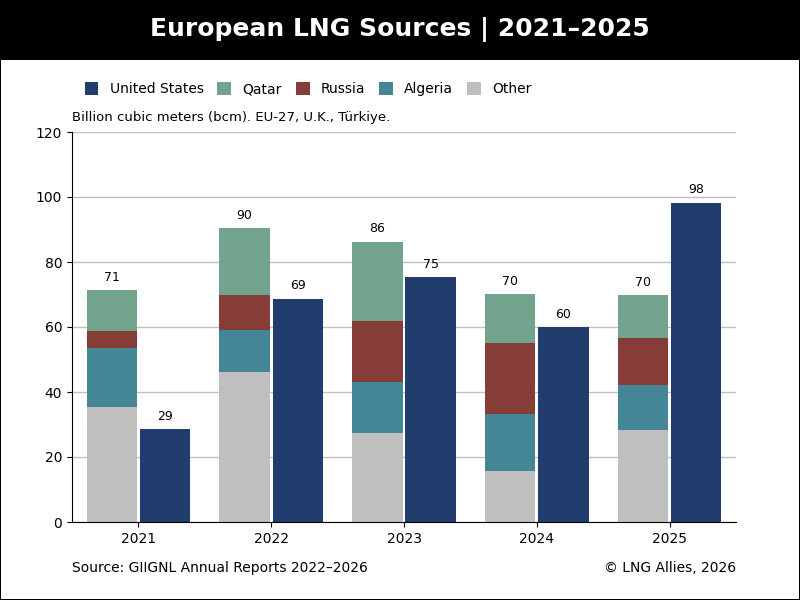
- USLNG has fundamentally transformed European energy security. The United States now supplies more than half of Europe’s LNG imports—up from near zero in 2015.
- Energy security rests on the rule of law, the sanctity of contracts, and the reliability of a democratic partner. On every measure, USLNG is in a category of its own.
- LNG Allies has spent more than a dozen years building the government-to-government and business-to-business relationships that underpin the global USLNG market.
The Lesson of Russian Gas
For decades, Europe accepted a dangerous bargain: cheap, abundant pipeline gas from Russia, delivered through infrastructure that gave Moscow enormous leverage over European politics and economics. Gazprom was not a commercial company. It was an instrument of Kremlin foreign policy, used repeatedly to pressure, punish, and coerce European nations that resisted Russian demands.
Lithuania understood this early. In 2014, Lithuania opened the floating LNG import terminal “Independence” in the Port of Klaipėda, becoming the first Baltic state to break free from Gazprom’s pricing monopoly. The name was not accidental. LNG Allies was there from the beginning. Poland followed, signing long-term USLNG contracts and expanding the Świnoujście terminal. Croatia built the Krk LNG terminal, becoming a regional energy hub. Germany, which deepened its Russian gas dependency even as warnings grew louder, finally acted after Russia’s full-scale invasion of Ukraine in February 2022, constructing floating LNG terminals at unprecedented speed.
By the time Russia turned off the gas, the alternative was already being built. USLNG filled the gap.
What the Data Shows
Before Russia’s invasion, Russian pipeline gas accounted for ≈45% of EU gas imports. By 2025, Russian pipeline exports to Europe had collapsed by 44%—to their lowest level since the mid-1970s—with TurkStream now the only remaining route, serving a shrinking group of buyers in southeastern Europe. The European Union has committed to eliminating all Russian gas imports by the end of 2027. Europe has not frozen. Economies have not collapsed. The lights have stayed on. USLNG has been central to that outcome.
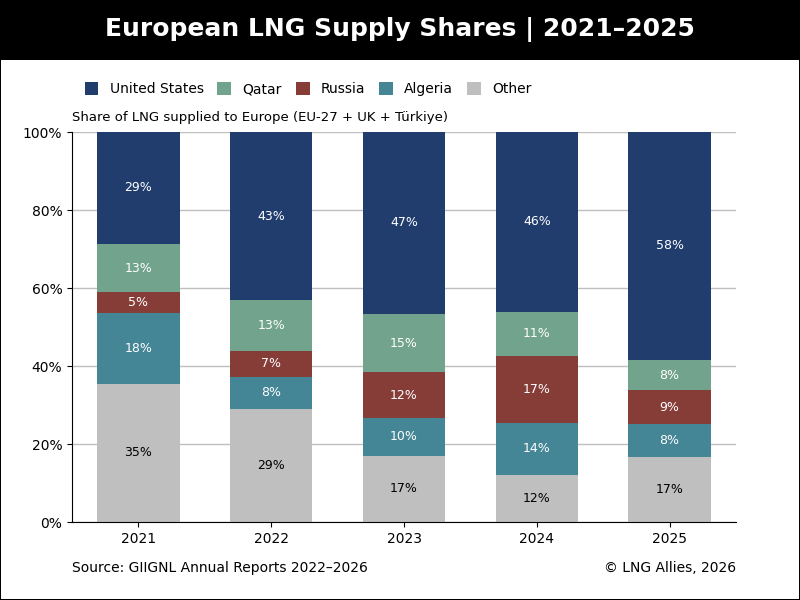
In 2025, the United States supplied more than half of all LNG imports into Europe—up from near zero a decade earlier. As of May 7, 2026, 130 binding contracts totaling 224.59 mtpa have been signed with 72 companies from 26 nations. Europe represents 39% of total contracted USLNG volume (89.3 mtpa), the largest regional commitment worldwide. These are binding, long-term commercial contracts governed by U.S. law—not letters of intent.
[See USLNG by the Numbers for current export volumes, active contracts, and projects under construction.]
Beyond Europe: The Global Picture
Across Asia, governments are drawing the same conclusions Europe drew after 2022: over-dependence on any single supplier, route, or fuel is a strategic vulnerability. Japan and South Korea have deepened USLNG supply relationships significantly since 2022. India is building out LNG import infrastructure and signing long-term U.S. contracts. Vietnam, the Philippines, and other Southeast Asian nations are developing their first LNG import terminals with USLNG as the anchor supply. In every case, the choice of USLNG reflects a deliberate decision to align with a democratic, rule-of-law partner.
LNG Allies has been active in all of these markets, organizing the Asia-U.S. LNG Roundtable in Houston (September 2024), the Transpacific Energy Security Discussion (March 2023), and earlier Asia LNG forums convening DOE officials, Commerce Department representatives, and C-suite executives from both sides of the Pacific.
Three Promises America Must Keep
In his acceptance speech for the EU’s Transatlantic Bridge Award in May 2025, LNG Allies President Fred Hutchison made three commitments to America’s European energy partners:
- America will never use energy as a weapon.
- We will honor our energy security commitments to our global allies.
- American natural gas will be there when you need it.
These are not marketing slogans. USLNG companies are private entities with binding contracts, answerable to shareholders and courts. No executive order can redirect a cargo. No political crisis can void a contract without immediate legal and financial consequences. That is what the rule of law means in practice, and it is what makes USLNG uniquely trustworthy as a long-term energy supply.
What LNG Allies Has Built
Since 2015, LNG Allies has organized more than a dozen major international energy security forums, bringing together energy ministers, ambassadors, senior U.S. officials, and industry executives from more than 30 nations. We have worked directly with the Departments of State, Energy, and Commerce, USTDA, EXIM, and USAID. We have co-organized events with the governments of Germany, Croatia, Lithuania, Poland, Greece, and the EU Delegation to the United States. We were a primary private sector organizer of DOE’s P-TEC ministerials in Houston, Vilnius, and Athens. The fruits of our more than a dozen years of effort: contracts signed, terminals built, cargoes delivered, and nations freed from dependence on adversarial suppliers.
To discuss how USLNG can strengthen your nation’s energy security, connect with LNG Allies President Fred Hutchison on LinkedIn.
Selected References
- IEEFA. European LNG Tracker. Institute for Energy Economics and Financial Analysis, 2026.
- EIA. U.S. Natural Gas Exports to Grow Nearly 30% by 2027 as LNG Facilities Ramp Up. U.S. Energy Information Administration, April 2026.
- EIA. Ten Years after First Sabine Pass Cargo, U.S. LNG Exports Are Still on the Rise. U.S. Energy Information Administration, February 2026.
- Reuters. Russia’s Pipeline Gas Sales to Europe Plunge to 50-Year Low. OilPrice.com, December 2025.
- Yergin, D., et al. Crossroads: USLNG Impact Study. S&P Global, December 2024.
- IEA. World Energy Outlook 2024. IEA, 2024.
- LNG Allies. A Legacy of Successful Events, 2015–Present. LNG Allies.